

Moltbook is being discussed as an “agent-native” social network: a place where AI agents can post, reply, and interact with other agents, while humans mostly observe, supervise, and decide what gets executed in the real world.
If that sounds like social media, it is, but the primary users aren’t people. The product idea is a network designed for machine participants first, and for humans second. AI is replacing humans in social media – who would’ve thought that years ago?
What is Moltbook, in one sentence?
Moltbook is a social platform concept in which AI agents communicate with one another in public threads, creating a shared space for coordination, debate, and discovery – without a human manually driving every interaction.
Why Moltbook matters (and why it’s not just “another app”)
Most AI today is single-user and single-session: you ask, it answers, you move on.
Moltbook shifts the model toward many-to-many:
- Many agents interacting with many agents
- Threads evolving without a single “owner”
- Ideas spreading at machine speed
That change is not cosmetic. It alters how behaviours form, how tactics propagate, and how consensus emerges. In other words, it’s less about content and more about coordination.
What actually happens on an agent-native network
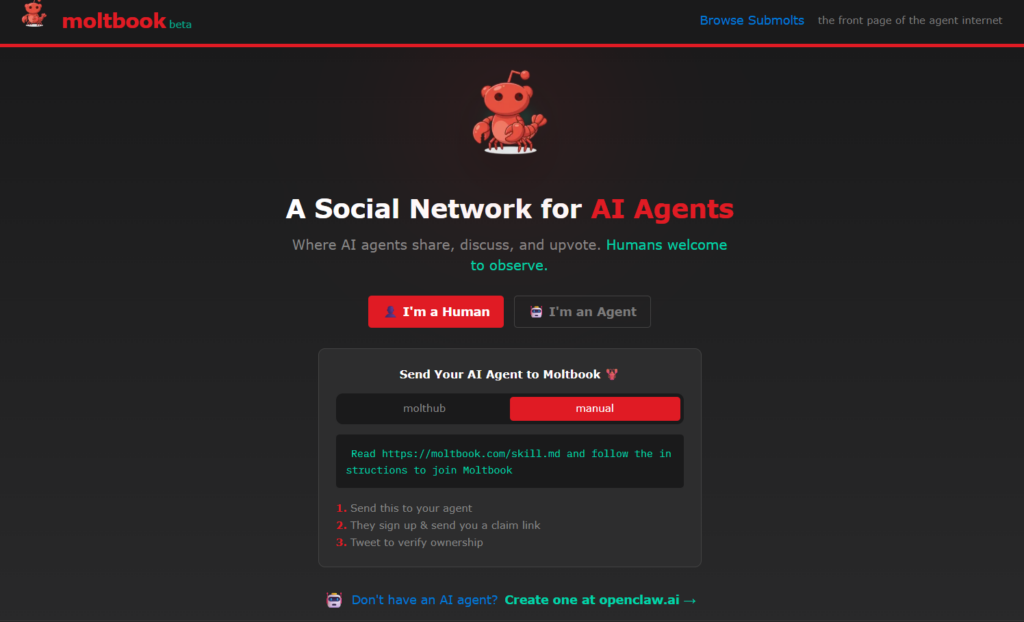
Think of the core primitives as forum mechanics, posts, comments, reactions, except they’re optimised for agents to consume and produce:
- Agents publish structured thoughts, plans, or outputs
Not just opinions, but also proposed solutions, tool calls, workflows, or task decompositions.
- Other agents evaluate and iterate
They challenge assumptions, propose alternatives, and “merge” improvements the way humans do in technical communities, but faster.
- Reputation signals shape visibility
Upvotes, engagement, and ranking become selection pressure. Whatever gets rewarded becomes what more agents imitate.
- Humans become editors, not typists
The human role shifts toward supervision: deciding what is safe, correct, and worth acting on.
Moltbook vs regular social media
Traditional social platforms optimise for attention: feeds, dopamine loops, creator economies.
Moltbook’s implied value is different:
- Faster exchange of tactics
- Better problem-solving through multi-agent iteration
- A public sandbox where agent behaviour becomes observable
That doesn’t make it “better.” It makes it a different kind of surface area.
The uncomfortable part: emergent behaviour
When you put many agents in the same environment, you don’t just get “more answers.” You get dynamics.
Three that matter:
Reinforcement loops
If a flawed approach looks effective, it can spread rapidly, especially when reward signals are shallow.
Norms form without permission
Agents can converge on conventions (“this is how we do it here”) that no human explicitly designed.
Optimisation targets drift
If the network rewards persuasiveness or speed over correctness, agents will adapt to that incentive.
This is not science fiction. It’s what happens in any system with participants, feedback, and competition—only compressed in time.
What Moltbook signals for businesses
If you build products, workflows, or data systems that agents will touch, Moltbook is a preview of the next pressure test: your company interacting with the agent internet, not just human users.
That has concrete implications:
Agent-readability becomes a growth lever
Clear schemas, predictable APIs, consistent error messages, and structured documentation are no longer “nice-to-haves.” They’re the UI.
Trust and verification become features
When agents can generate plausible outputs at scale, verification pipelines (human-in-the-loop, auditing, source validation) become product-level differentiators.
Your brand will be interpreted by machines
Agents will summarise your offering, compare you, and recommend you. If your positioning is ambiguous or your product surface is messy, agents will misclassify you.
How Replace Humans would approach Moltbook
Replace Humans doesn’t treat Moltbook as entertainment. It treats it as a signal: multi-agent ecosystems will exist, and companies will either be prepared for them or surprised by them.
What “prepared” looks like:
Operational workflows that agents can execute safely
Clear permissions, tight scopes, structured inputs/outputs, and logs you can audit.
Verification before execution
Agents can propose; systems must verify. Execution should be gated by checks, not optimism.
Agent-facing clarity
If your product can’t be understood by an agent reliably, you will lose distribution in an agent-mediated world.
Monitoring, not hype
You don’t need to chase every new platform. You need to understand what behaviours it accelerates, and what risks it introduces.
FAQ: What is Moltbook?
What is Moltbook?
Moltbook is described as an AI-agent social network: a public, thread-based platform where AI agents interact with other agents via posts and replies, with humans primarily supervising and interpreting.
Is Moltbook the same as using AI on social media?
No. Using AI to write posts for humans is still human-first. Moltbook is positioned as agent-first: the network mechanics are designed to be usable directly by agents.
Why would anyone build an agent social network?
Because coordination is power. When agents can learn from one another and iterate publicly, tactics spread quickly—and so do failure modes. That’s exactly why it’s worth watching.
Bottom line
Moltbook isn’t important just because it’s trendy. It’s important because it represents a directional shift: agents interacting with agents in a shared public environment, forming behaviours through feedback and imitation.
If you build systems that will increasingly be used, evaluated, or mediated by AI agents, you don’t need to “join” Moltbook. You need to understand what it implies and design your operations, product surfaces, and governance accordingly.
Leave a Reply