

For years, “robots replacing humans” sounded like a slogan. In 2026, it looks increasingly like an operations strategy.
What has changed is not merely that robots have become better. It is that physical AI has begun to connect software intelligence with deployable hardware at a scale that matters commercially. Warehouses, assembly lines, aviation plants, delivery networks and defence systems are no longer treating robotics as a distant layer of innovation. They are integrating it into throughput, cost control, resilience and national competitiveness.
The more precise way to describe what is happening is this: robots are not replacing all humans at once, but they are replacing human labour in an expanding set of physical tasks that used to require a person to be on site, on shift, and on payroll. That distinction matters because task replacement is how real labour displacement begins. It starts with dull, dangerous, repetitive or highly standardised work. Then it moves upstream.
Will Robots Replace Humans?
This is the question everybody keeps asking, and the honest answer is more nuanced than either the optimists or the alarmists usually admit.
Robots are not about to replace all humans across the economy. What they are already doing is replacing specific kinds of human work at an increasing speed. The pattern is clear: the more repetitive, physical, measurable and standardised the task is, the easier it becomes to automate. That is why warehouses, factories, delivery networks and certain field operations are moving first.
In practice, robots rarely erase an entire profession overnight. They remove parts of it. A machine takes over transport, lifting, sorting, inspection or routine assembly. Then workflows are redesigned around that capability. Then fewer people are needed for the same output. This is how replacement actually happens. Not as a dramatic one-day event, but as a gradual reduction in how much human labour a business needs to buy.
That is also why the better question is no longer simply “Will robots replace humans?” but “Which parts of human work are already becoming optional?” In many industries, that answer is changing faster than most companies are willing to say publicly.
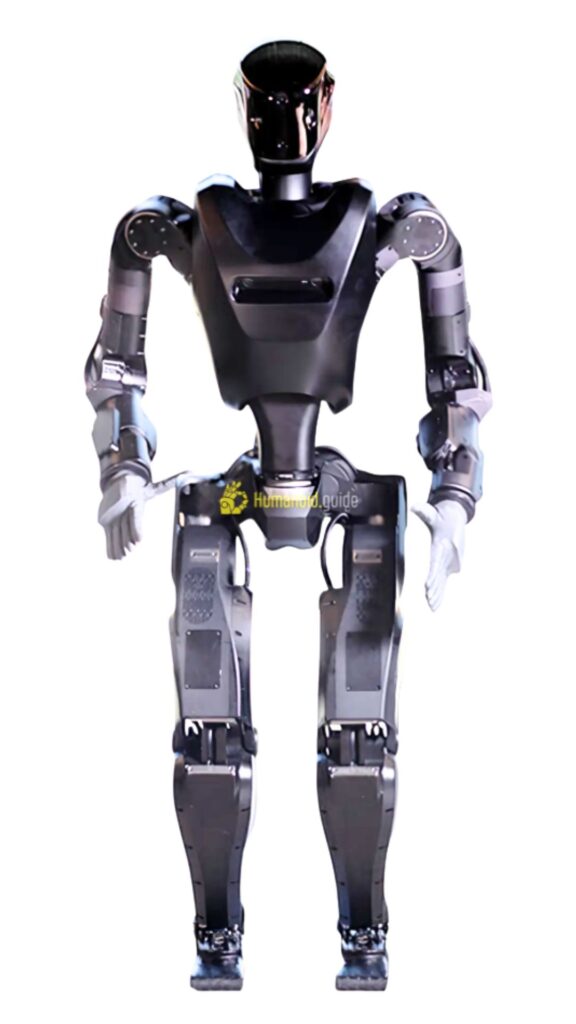
The Phantom MK1 (the picture above) is a humanoid robot developed by the US-based Foundation and is already positioned explicitly for defence applications. Standing 175 cm and weighing 80 kg, it is built to operate in environments designed for humans — meaning it can use the same doors, vehicles, tools and corridors that soldiers do.
With a 20 kg payload capacity, cycloidal actuators for compliant movement, and an LLM-driven control stack that translates high-level instructions into full-body motion, it represents exactly the kind of dual-use platform that blurs the line between industrial automation and battlefield utility.
Reports indicate the robot is being evaluated for deployment in Ukraine — a conflict that has already become a proving ground for drone autonomy, remote weapons systems and unmanned logistics. If humanoids begin operating in active war zones, the question of human replacement ceases to be a productivity discussion entirely.
2026 is the year robotics stopped being a lab story

The most important shift in 2026 is not that humanoids suddenly became universal. They have not. The real shift is that robotics has crossed from demo culture into deployment logic.
Some of the clearest evidence comes from logistics and industrial automation, where robots are already embedded deep inside operations. In these environments, robotics is no longer an experimental layer or a futuristic PR angle. It is infrastructure.
That distinction matters because robotics in 2026 is a market of asymmetry. Some companies already have robots integrated into day-to-day workflows at a meaningful scale. Others are still marketing future substitution as present reality. Serious analysis has to separate those two groups.
Manufacturing is where human replacement becomes measurable
Manufacturing remains the clearest example of real human substitution because production environments are structured, repetitive and economically unforgiving.
Across automotive and electronics production, the direction is now obvious. Companies are introducing robots where labour is constrained, ergonomics are poor, cycle times are measurable, and the return on deployment can be calculated with precision. That includes component handling, materials movement, repetitive inspection, machine tending and assembly assistance.
This does not mean a robot has replaced an entire department. In most cases, it means the machine has entered live production under real performance conditions and has begun taking over part of the workload that was previously human. That is the threshold that matters. Once a robot can operate in a real production environment rather than in a controlled showcase, the conversation shifts from innovation to scale.
The commercial logic is straightforward. Robots do not need shift breaks in the human sense. They do not face fatigue in the same way. They generate operational data continuously. They can be retrained, updated and redeployed. Once the economics work, human involvement shifts from direct execution to supervision, exception handling and maintenance.
Warehouses are already post-human in large parts of the workflow
If manufacturing is the proving ground, logistics is the scale engine.
Warehouses are among the first environments where large-scale human replacement becomes visible because the work is highly repetitive, spatially structured and deeply tied to throughput. Picking, sorting, transport, pallet movement, and route optimisation are all tasks that machines can increasingly handle consistently.
In many modern fulfilment operations, the real question is no longer whether robots can assist workers. It is how much of the facility still genuinely requires a human at all. People remain in the loop, but the centre of gravity has shifted. Humans supervise, intervene, repair, troubleshoot and manage exceptions, while robots handle an expanding share of physical movement.
That changes labour architecture. The traditional model required large pools of staff doing repetitive physical work over long shifts. The new model reduces the amount of human time needed per unit processed. Even when headcount does not collapse immediately, labour demand becomes thinner, more selective and more technical.
Delivery, field services and mobile robotics are removing humans from the last mile
The last mile used to be one of the hardest environments to automate because it is public, unpredictable and difficult to standardise. That is still true. But the barrier is weakening.
Autonomous delivery robots, mobile service units, and semi-structured field robots are now proving that small-payload transport and short-range repetitive movement can be automated in specific urban environments. The implication is not that all couriers disappear tomorrow. It is that a growing portion of low-complexity delivery no longer needs a human for every trip.
This matters because labour economics is driven by minutes as much as by roles. The fewer human minutes required per delivery, per movement, per handoff or per inspection, the more pressure builds on the value of the role itself. Once enough fragments of a job are automated, the job begins to shrink in economic importance even before it disappears in formal terms.
China is not just participating in the robotics race. It is industrialising it
Many discussions about robotics still focus on a few familiar Western brands. That misses the deeper story. The centre of gravity in robotics manufacturing is increasingly in China.
China’s advantage is not just that it produces robots. It is about building the surrounding ecosystem at scale: hardware manufacturing, components, supply chains, AI integration, domestic demand, and state-backed industrial momentum. That makes a major difference. The future of robotics will not be decided only by who has the most impressive prototype, but by who can manufacture, deploy and iterate faster.
This is where China looks especially strong. It is moving robotics beyond isolated innovation and into industrial capacity. When a country combines large-scale robot deployment with aggressive development of humanoids, autonomous systems, and defence-linked technologies, robotics ceases to be a product category and becomes part of the national infrastructure.
That does not mean every publicised deployment is mature or transformative. Some systems are still in pilot stages, some are overhyped, and some remain closer to demonstration than labour replacement. But the broader trend is clear. China is building for industrial scale, not just attention.
Defence is pushing robotics from an efficiency tool to a geopolitical weapon
The military dimension makes this entire subject more serious.
Civilian markets may move due to labour shortages, productivity pressures, and operational efficiency. Defence markets move because states are willing to spend aggressively to remove humans from danger, extend surveillance, accelerate decisions and scale force at lower marginal cost.
That changes the pace of development. Military funding accelerates the development of sensors, autonomy, navigation, edge computing, rugged hardware, and machine perception. Technologies developed for defence do not remain isolated forever. They spill into logistics, industrial inspection, mobility and public safety. In that sense, military robotics can also indirectly accelerate the replacement of civilian labour.
This is also where the ethical issue becomes impossible to ignore. Once autonomy shifts from warehouse operations and assembly support to surveillance, targeting, and battlefield support, the stakes change entirely. Human replacement is no longer only a labour market story. It becomes a question of control, accountability and the acceptable limits of machine decision-making.
Phtanom MK1 humanoid robot is reportedly already being deployed in the Ukrainian war, while other killer robots are being tested in military labs worldwide. So, it’s not only China we’re witnessing here in the military field; more countries are developing or already using humanoid robots in conflicts.
The real replacement pattern is not jobs first. It is tasks, shifts and leverage
One of the biggest mistakes in this debate is to look only for a dramatic metric called “jobs replaced”. That is not how displacement usually arrives.
The first stage is task substitution. A robot takes over a repetitive movement, transport action, inspection step or lifting function. The second stage is shift redesign. Once machines can operate across longer windows with fewer interruptions, managers redesign staffing around the machine rather than around the human. The third stage is organisational leverage. Fewer workers are needed to supervise larger amounts of physical output.
That is when headcount pressure becomes more apparent.
This is why the statement “robots replace humans” is both true and incomplete. It is true because replacement is already happening in bounded workflows. It is incomplete because companies usually replace fragments of labour before they replace full roles. But once enough fragments disappear, the role itself starts to erode.
Previous waves of automation often had clear physical limits. Machines could repeat fixed motions well, but they struggled with adaptation, variability and perception. The latest wave is different because AI is improving the robot’s ability to interpret environments, respond to changing conditions and coordinate across systems.
That does not make robots universally competent. It does make them more commercially viable in places where older automation would fail. A smarter robot does not need to be human-level in general intelligence to be economically disruptive. It only needs to become reliable enough at a narrow but valuable set of tasks.
That is exactly what is happening.
The result is that robotics no longer depends only on hardware engineering. It improves through software, data and model refinement. That makes deployment more dangerous for labour than traditional fixed automation, because capability can compound after installation.
What this means for your business
For companies, the immediate implication is blunt: any physical process that is repetitive, measurable, expensive to staff, ergonomically poor, dangerous or difficult to hire for is now a candidate for robotic substitution.
That includes intralogistics, component handling, warehouse movement, repetitive inspection, selected agricultural work, plant monitoring, security patrols, certain delivery routes and parts of frontline service.
The firms that win will not simply buy robots. They will redesign workflows around machine strengths: endurance, consistency, telemetry, route optimisation, lower error variance and software-driven improvement after deployment.
That is the more serious threat to labour. Once capability becomes software-improving, replacement stops being a one-off capital purchase and becomes a compounding system.
The honest conclusion
So, are robots replacing humans in 2026?
Yes, but not in the simplistic version of the story.
They are replacing humans first in work that is physical, repeatable, structured, and cost-sensitive. They are replacing portions of shifts before they replace departments. They are moving faster in logistics than most people realise, and they are becoming more commercially credible in manufacturing with every new deployment cycle.
The biggest mistake now is to ask whether the robot age is coming. It is already here. The real question is which organisations still think they are competing only against other human-run businesses, when in fact they are increasingly competing against machine-amplified ones.
Leave a Reply